Why Does the Cash Flow Statement Matters?
Learning how to analyze a cash flow statement is one of the most valuable skills an investor can develop. Cash is the fuel that powers business growth, while profitability is a measure of performance. Although a company may report strong profits, it cannot invest in new projects, repay debt, or fund day-to-day operations without cash. That is why experienced investors pay close attention to the cash flow statement.
While many investors focus only on profits, experienced investors know that the cash flow statement reveals whether a business is generating real cash to support future growth.
Investors are often willing to pay a premium for companies with strong future growth prospects, and that growth depends on cash, not profitability alone. A profitable business can have a compromised growth if it struggles with cash required to fund new capital projects or it struggles with working capital to meet its day-to-day operations’ needs.
An income statement calculates profitability whereas a Cash Flow statement explains how that profit was utilized, how much of that was turned into real cash. Public companies generally publish cash flow statements as part of their quarterly and annual financial reports. Understanding how to analyze a cash flow statement helps investors evaluate a company’s financial strength beyond reported profits.
So what do we see in a Cash Flow statement?
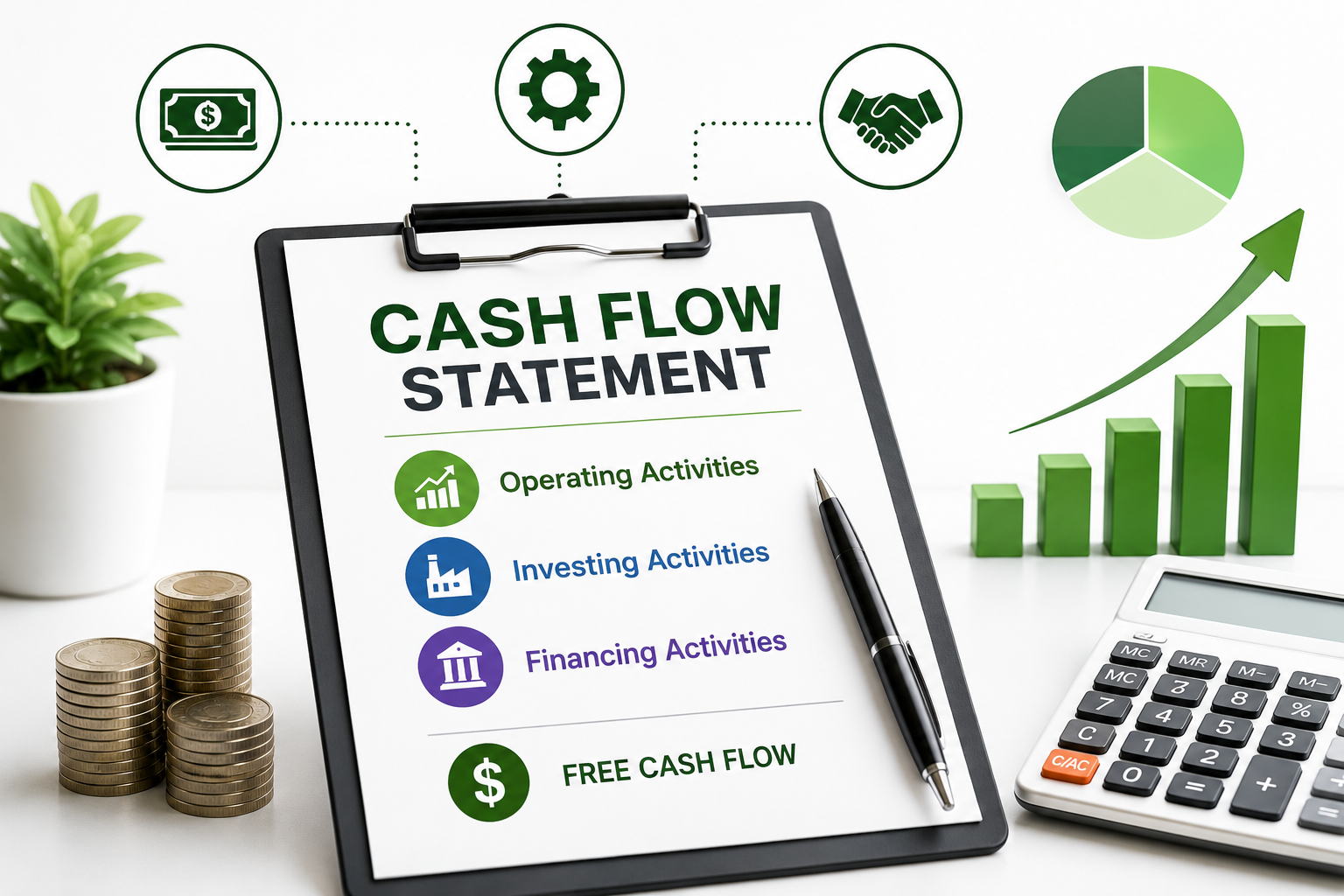
A Cash Flow statement comes with three broad sections
1. Cash Flow from Operating Activities
2. Cash Flow from Investing Activities
3. Cash Flow from Financing Activities
Let’s dive into details for each of the above explained categories. Before analyzing a cash flow statement for investment decisions, it is important to understand how it is prepared.
The starting point of any Cash Flow statement is the Net Income. Once a company reports net income on its income statement, the next step is to explain what happened with that net Income
Since the Net Profit is calculated using accrual accounting, it is important to convert accruals to cash concept before starting Cash Flow statement
Adjustments to Net Profit
For this, Net Income is added back for all the deductions that are non cash in nature
A few examples of those add backs are Accrued Interest, Amortization and depreciation of non current assets, any unrealized FX gains/losses as they are just accounting adjustments and have no real cash event linked to them. Once the adjustments are added back, we move to first section of cash flow statement which is cash flow from Operations
Cash Flow from Operations

Unlike accounting profit, cash from operations tells investors how much cash the core business actually generated during the period
In this section we adjust for working capital to remove the accrual impacts from the net Profit. Balance sheet statements are required to make these adjustments. For details on Balance sheet statements, check this article on Balance sheet statements for Investors
Working capital includes Accounts Receivables, Accounts Payables, Inventory and some other deposits and prepayments. Because net income is prepared on accruals concept, cash needs to adjust for those assumptions. For example an increase in Receivables by $5m over a period is taken into account in profitability as Revenue but not all of that revenue is collected as cash. This means any increase in receivables needs to be subtracted from Net Income to subtract the uncollected Revenue already recorded in Profit. Any decrease in Receivables is taken as cash addition as it signals cash in, not recorded in profitability
Similarly Accounts payables, inventory, prepaid expenses, deposits are treated as working capital adjustments. Once the adjustments are made, the resulting number is called “Cash from Operations” For an investor the simple interpretation is that the cash left over after business meets all its day-to-day working capital needs. If this cash is positive, it signals the business has enough room to use the remainder cash for capital projects or for financing needs. A negative Cash Flow indicates business is struggling to meet its day to day operations
Cash Flow from Investing Activities
This section includes all the cash used for capital investments. This could be like adding another project in a plant, acquiring a new production equipment, acquiring another business, buying intangible assets and selling assets.Investors analyze this section to understand how much the company is investing in future growth and whether those investments are being funded through internally generated cash or external financing.
Cash Flow from Financing Activities
Many businesses use financing for their growth. It could be debt financing increasing their leverage or capital financing by going public and issuing stocks to the general public which creates dilution of earnings. Share buy backs and dividend payments are also included here. All those events are recorded in this section which makes this section very important for investors to understand the financing structure of a business.
How to Analyze a Cash Flow Statement
Once you know how to analyze a cash flow statement, it becomes much easier to identify financially strong businesses.Investors review each section to understand the current cash utilisation and foreseeable future of the business. A growing operating Cash Flow indicates, not only stronger demand in terms of revenue but efficient Inventory management, collections of Receivables on time, paying suppliers efficiently to maximise supplier financing. The investment section shows how the management is handling investing activities. Does business operations generate enough cash and allows business growth through investments and if yes how much of that growth is coming from what type of financing.
The financing type used for growth indicates a business using debt financing or capital financing. This section helps investors assess how dependent a company is on debt or equity financing and whether its capital structure remains sustainable. An investor can see the management’s risk appetite when looking at investing and financing activities. Depending on the industry type, risk appetite can be justified for example in the Technology sector. Therefore , these metrics should always be benchmarked against the industry standards
Free Cash Flow

Free Cash Flow refers to the cash remaining after a company generates cash from operations and pays for the capital expenditures needed to maintain or grow the business. It represents cash that can potentially be used to repay debt, pay dividends, repurchase shares, or invest in future opportunities.
While it’s good to have a positive free Cash Flow indicating business still has the fuel available to meet future growth, having a huge reserve of free cash can sometimes signal a red flag. Cash sitting idle generates little or no return and gradually loses purchasing power due to inflation. Investors should therefore evaluate how effectively management allocates excess cash
What are the possible Red Flags?
It is essential for an investor to analyze Cash Flow statements in conjunction with other statements. A business with increasing profitability over time and lower operating Cash Flow for several consecutive years indicates a problem with working capital management.
This means even if a business is generating good revenue with controlled costs, it is not collecting its receivables from the market on time, inventory management is poor, supplier payments are being made way before the due dates. A profitable business may not be able to survive in the foreseeable future if working capital is not managed well
A business with negative operating Cash Flow and heavy borrowing increases the risk profile of the business. Borrowing comes with higher interest expense making covenant scrutiny more rigorous from banking partners.
A Real World Example
Apple Inc Cash Flow statement Year 2025
| Breakdown | 2025-09-30 |
| Operating Cash Flow | $111.5 billion |
| Investing Cash Flow | $15.2 billion |
| Financing Cash Flow | $(120.7) billion |
| End Cash Position | $35.9 billion |
| Income Tax Paid Supplemental | $43.4 billion |
| Capital Expenditure | $(12.7) billion |
| Issuance of Debt | $4.5 billion |
| Re Payment of Debt | $(10.9) billion |
| Re purchase of Capital Stock | $(90.7) billion |
| Free Cash Flow | $98.8 billion |
Apple generated approximately $111.5 billion in cash from operating activities during fiscal 2025, demonstrating the company’s exceptional ability to convert its products and services into real cash. This strong operating cash flow comfortably funded approximately $12.7 billion in capital expenditures, leaving Apple with nearly $98.8 billion is free cash flow
The company then returned a significant portion of this cash to shareholders through share repurchase of approximately $90.7 billion while also paying dividends. This is a classic example of a mature, highly profitable business generating more cash than it needs to operate and invest for future growth.
Apple’s cash flow statement demonstrates why cash generation is one of the strongest indicators of financial quality. Despite already being one of the world’s largest companies, Apple continues to generate enough cash to invest in its business while returning substantial capital to shareholders.
Key Take aways
Learning how to analyze a cash flow statement allows investors to make better long-term investment decisions.
- Cash is the lifeblood of every business.
- Strong operating cash flow indicates a healthy core business.
- Free cash flow provides flexibility for growth, debt repayment, dividends, and share buybacks.
- Review operating, investing, and financing cash flows together for the complete picture.
- Always compare the cash flow statement with the income statement and balance sheet before making investment decisions.
Capital Lenses Insight
A cash flow statement tells the story behind a company’s cash generation, investments, and financing decisions. While profits often receive the most attention, experienced investors know that cash ultimately determines whether a business can survive, grow, and create long-term shareholder value

Tabasum Imtiaz
August 6, 2026